Posts

The benefits of a regular release schedule

I have recently read the announcement that Kubuntu 8.04 is NOT going to be an LTS release, thereby deviating from the release schedule of all the other Ubuntu variants. I believe that it would be more beneficial to synchronize the LTS releases between the official Ubuntu variants. First of all, Ubuntu needs to solidify its public image as much as possible. This is even more important while it has such a small mind-share in the overall technology market. Most computers users have no idea what an LTS release is, and they could be confused by mis-matched numbers. "Why is Ubuntu 8.04 LTS and Kubuntu 8.04 not LTS? Why is Ubuntu 8.10 not LTS and Kubuntu 8.10 is LTS?" Some IT departments might choose to only support LTS releases of Ubuntu. Now they must work with their KDE users who would need to upgrade on a different schedule than their Gnome users. I understand why Kubuntu wants to delay their LTS release. They have a shiny new version 4.0 that provides many new features...

Proactively defending the GPL

I keep hearing people talk about the need for a legal test case against the GPL. This has not happened yet in the US, and some people think it is necessary to legally legitimize the GPL license. These GPL-supporters hoped that the recent Busybox vs Monsoon Multimedia issue would satisfy this requirement. This turned out not to be the test case because it settled outside of court. After hearing much debate and concern about how and when this all-important test case will take place, a very simple idea entered my mind. Why don't we just create this test case ourselves? Start with two pro-GPL parties, and have one party infringe against the GPL license. Then have the other party sue the first for its violation of the GPL license. Of course the specifics can be determined in advance to make the decision most favorable to defending the GPL. I expect that the legal costs for this case will be minuscule compared to the value it would bring. Once the case has been decided in favor o...

Ubuntu Utah release party

Image
On October 20th, the Ubuntu Utah team held a " Gutsy Gibbon " release party in Salt Lake City. It was a cold and rainy day, and some people decided to stay home where it was warm and dry. Even so, we had around 20 people in attendance, including many new faces. This was a great time to meet people and ask them, " Why Ubuntu? ". Here are two Ubuntu laptops, but the guy at the end was using Windows. I tried to convince him to give Ubuntu a try, but he was too busy working on his resume. Need I point out that in this case, (Using Windows) = (Looking for a job). Nothing like anecdotal evidence, right? Please ignore the Fedora guy who came to crash the party. Just kidding Clint! I believe he was actually running Ubuntu in a virtual machine. This is my Ubuntu baby, and her name is Chloe. She hopes to become a member of the Ubuntu Women team even though she is only 6 months old. Isn't she the cutest Ubuntero you ever did see? :)

Ubuntu 7.10 should make Dell happy

Image
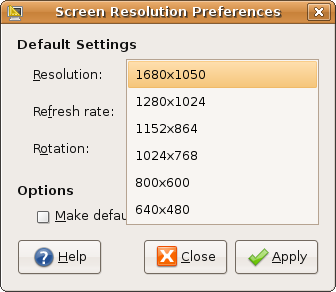
I have just upgraded my new Dell computer that came with Ubuntu 7.04 to the pre-release version of Ubuntu 7.10 (Beta). Please read my initial review of this system . After a large download and subsequent reboot, this computer came up in much better shape than it was in 7.04. Most notably, it detected the correct resolution and came up in 1680x1050. I also had many more resolutions to choose from. Instead of the three resolutions I had before, I now have six choices. Secondly, the Ubuntu Restricted Driver Manager correctly detected my NVIDIA video card and prompted me to enable the driver for it. Once I told Ubuntu to enable the NVIDA driver, it downloaded the driver and requested that I reboot my computer. After the reboot, I was saddened to see that it came up again in 1024x768. I opened the screen resolution tool and found that my optimal resolution was no longer a choice. In fact, while I still had six resolutions to choose from, 1024x768 was the highest one. Any ideas why th...

Review: My Ubuntu PC from Dell

Image
Introduction Ever since Dell announced that they would be selling computers with Ubuntu pre-installed, I have wanted to buy one. This is not because I was unable to install Ubuntu myself, but because I wanted to reward Dell for choosing Ubuntu. I also wanted to make a statement that there was consumer demand for Linux to be pre-installed on computers. Secondly, I have read Walt Mossberg's review of his Ubuntu laptop from Dell and I wanted to see how my experience compared to his. It is important to keep in mind that both Dell and Ubuntu have stated that the current versions of Ubuntu are intended for advanced users only. This is the reason why Dell does not advertise Ubuntu more on their website. Dell knows that advanced users will be able to find the place to order their Ubuntu computer, while main-stream users are simply offered Windows operating systems. I have a feeling that Dell will promote Ubuntu more once the 8.04 LTS release comes out in April of 2008. Ordering the ...

Advantages of open source: Revisited

I feel that is important for me to further analyze the benefits of open source software. In a previous post , I highlighted the cost-savings of open source and did not mention any of the other advantages that it provides. This post should provide a more balanced view of open source and the intrinsic benefits that free software provides. Low Cost This is the benefit that I focused on in my previous post . Cost is the most obvious benefit when people compare it to proprietary software. How does open source achieve this low cost? I believe that the open source development model is the most efficient way to create software. With proprietary software development, each software company creates an isolated software silo. Meanwhile, their competitors are spending resources to create software that does almost the exact same function! Compare that to the open source model, where worldwide resources can be shared to develop an application. Some people claim that while open source software m...

Digium is doing things right

Image
Background Digium is the company behind Asterisk , the popular open source PBX . Digium was founded in 1999 by Mark Spencer , the creator of Asterisk. Since then, Asterisk has been deployed around the world on millions on computers. Despite that fact, Asterisk still does not have a large market share of the PBX market. Why is this? In the past, there were many reasons for this: No brand recognition of Asterisk No proven track record of successful implementations Commercial support was needed No Linux expertise on staff Afraid to use open source software These concerns were once valid, but today most of them have been addressed by Digium. They made Asterisk easy to use Digium has been working hard to overcome the historically steep learning curve associated with implementing Asterisk. They have accomplished this with two major improvements. First, Digium created an open source software appliance called AsteriskNow! that bundled Asterisk inside a pre-configured version of Linux. ...